
Researcher of the Month
March 2026
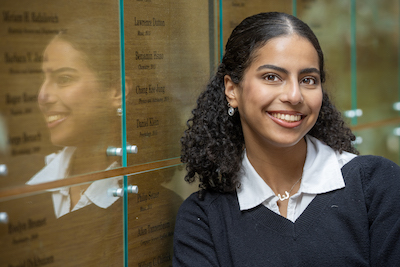 Lana Gouda
Major: Political Science ; Class of 2026
Research Mentor: Dr. Jason Rose, Political Science
Link to SBU News article and video feature (3/16/2026)
“I had so many ideas… I had a whole document full of ideas that I wanted to write about, and I had equal interest in all of them, so it was really difficult honing in to what my thesis topic eventually became”…-Lana Gouda, Class of 2026
Lana Gouda is a senior double majoring in Political Science & Economics with a minor in philosophy.
She is currently completing a departmental honors thesis with Dr. Jason Rose on “Middle East Reform Efforts in specific countries focusing on Social Change, Gender
Roles, and Economic Freedom.” Lana was the recipient of the inaugural Harsh Bhasin Scholarship given by the Department
of Political Science and has served as a Teaching Assistant for POL380: Government
and Politics of the Middle East. In Fall 2024, she was selected to receive the Edward
Guiliano Global Fellowship-College of Arts & Sciences (CAS) award which provided her
with the resources to travel to Nice, France, to enhance her language skills.
On campus Lana has served as president of The Political Science Society and of Pi
Sigma Alpha (Political Science honor society), and as a member of the Dean’s Student
Leadership and Advisory Council (College of Arts & Sciences). She also has had roles
as Undergraduate Coordinator For Events and Initiatives (Office of Student Life),
Orientation Leader, Peer Assistant Leader, Undergraduate Project Leader (Academy of
Civic Life) and International Student Ambassador (New Student and Transition Programs)
and is an event coordinator for the Arabic Language and Culture Club. Lana is also
a member of the select Women’s Leadership Council. Lana has had internships as a translator/interpreter,
worked as an economic research intern for the US Department of State-US Mission to
Yemen, and was a campus outreach coordinator for the Collegiate Network of Middle
East Affairs (CIMEA). Following graduation, she will be joining Wolfe Research as
a research coordinator.
Be sure to look for Lana’s poster at the upcoming URECA Symposium on May 5th!
Lana's hobbies include listening to music, making playlists and playing the piano; running and hiking, and watching movies. Below are excerpts of her interview with Karen Kernan, URECA Director.
The Interview:
Karen: Tell me about your research project, what you're currently working on.
Lana: My senior thesis is about reform efforts in the Middle East focusing on social change, gender roles, and economic freedom in Saudi Arabia and other countries as case studies. I take a look especially at the religious extremist education policy from the 1970s and analyze its effect on impeding contemporary reforms. I'm pinpointing the 1970s, analyzing that period, specifically Saudi Arabian “madrassas” , but I’m planning to include other countries as well in my research. What can we learn, and what can we take away from what happened at that time with regard to education policies and their wide influence on ideology? How can we leverage what we learned from that time to ensure the reforms happening right now are stable and won’t just repeat a cycle of minuscule progress, then immediately revert to what it was before? I'm also making the case for reform from within, rather than outside intervention.
When did you start thinking about doing a senior thesis?
Probably ever since I took POL380: Politics and Government of the Middle East class in my first year when I wrote a paper that I knew had the potential to be expanded into a bigger project or thesis. The biggest problem was that I had so many ideas, and I didn't know how to put them into one paper. I talked to my professor, Jason Rose, a lot about it, and I began compiling all of my ideas the summer before senior year, so that I could spend the fall semester doing literature reviews, and have some time to really figure out and develop exactly what I want to do for my thesis.
I still have that freshman year paper as a backup, and could expand on that very general paper I wrote about democracy in the Middle East, and what social reforms could be implemented in order to make sure that Middle Eastern nations can maintain democracy–a lot of discussion of democratization versus development, and development versus democratization. But I wanted to write something new for my senior thesis and try to tackle some of the other major issues.
DId you have any experience prior to starting on your thesis?
Yes, I first got involved in research during my spring semester of sophomore year, working with PhD candidate Adam Panish. He was researching different statistical methods used in political science journals from the 1900s onward. As an economics major, I found that the project branched both of my majors/interests. And it was very interesting because he would look into whether the information would be different if it came from a private rather than a public source. A lot of the work we did as research assistants involved compiling links, finding journals, and entering information (for ex., the abstract, the links). Sometimes we would skim articles and write short summaries. But because I didn't know what to expect at all, I found the experience to be somewhat transformative, and I never viewed it as “busy work” because we had consistent meetings with him where he would tell us how this research was getting used, how all of our work was getting used to aid his own research. And I loved the experience, and that's why I applied again.
In my junior year, I applied to work with Professor Ruben Kline. My favorite part of that was being placed on the financial incentives team, and I needed to get certified to conduct research on human subjects to do the work… I learned so much from the training, and I still refer back to that information sometimes. I thought the experience was very helpful, and it helped prepare me in some ways for what I’m doing now with my honors thesis.
And how did you get that first research position?
Thinking back to my first year, I was always interested in pursuing research, but I didn’t initially know how to get started in political science. A lot of my friends who were doing research were in more STEM-y fields…So, fairly early on, I talked to Professor Rose, and he directed me to some professors in the department who were looking for undergraduate research assistants. There's a big list in the department of the various research opportunities.
What are some of the major challenges in doing a senior thesis?
I think narrowing down my ideas was my biggest challenge, because there's just so much that can be written about. I had a whole document full of ideas that I wanted to write about, and I had equal interest in all of them, so it was really difficult honing in on what my thesis topic eventually became…
My professor suggested the exercise of writing 5 words of the broad topics that I'm most interested in, just 5 words, and seeing where these topics lead me. And my interests included radicalism, extremism, women's rights, social change, and all of these things became important in eventually settling on my topic.
I had taken Politics and Government of the Middle East in my freshman year, and I think in some ways that the class influenced my whole undergraduate experience and my drive to focus on the Middle East. I took similar classes, such as the Politics of Africa, and other regional classes. And at some point, I figured out that my favorite subject is studying the Middle East, especially times of reform or revolutions such as the Arab Spring. Personally, being born and raised in Egypt and being there during the Arab Spring, I think that from the very start I was set on this path of studying the Middle East and conducting research about it.
What excites you most about your topic?
I think it’s partly how personal it is. I'm very happy that I get this opportunity to give back to that part of my identity, and that deepens my understanding through the research in a way that is very evidence-supported.
I've always enjoyed talking and having many discussions about my topic, so now that I get to kind of write my own take and find evidence towards that…it actually challenges a lot of what I believed. I’ve learned so much more about particular historical developments, treaties, and conflicting interests. And beyond challenging a lot of my preconceived beliefs, it's just very exciting to be doing research about something that I chose, and something that I've been very interested in.
Did anything particularly surprise you in all the research that you did to prepare for your senior thesis?
I think what continues to surprise me the most is how many different takes there are on the topic. Sometimes, with our own research, we feel like it's so obvious what our conclusions are, and we can think: How do people not see this? But then the more you read about it, the more you see that there are just completely different interpretations. I always try to make sure that I read opinions or viewpoints that I disagree with, so that I can understand and critically dispute them in my research as well.
Writing a thesis is a lot of work. What for you is the primary benefit of doing a thesis?
When I first started thinking that I wanted to do it, I thought I was going to use it as a writing sample for grad schools or for work. But mostly, I think I wanted to see this project through, because I know I have a lot of opinions, and by putting in the work on a project like this, I wanted to prove to myself that I can back what I believe in with papers and with evidence, and at the end of the day have something to show for my experience at Stony Brook with the political science department. I just felt like I needed to do it, and I'm mainly just doing it for myself to see this project through.
How has your mentor, Professor Rose, helped you with this endeavor?
Professor Rose has helped me from day one. He always knew what to say when I feel
too overwhelmed, and helped remove any doubts …If I didn't have access to a certain
source, he would immediately go and help me find it. And if I had writer’s block,
he’d ask questions that redirect my thinking and inspire me to write. Other than helping
me with the actual paper, he's been a constant support and is a big reason why I decided
to do the honors thesis in the first place. The same goes for being a TA, being a
research assistant, and a lot of my experiences/internships. He pushes students to
believe in themselves and makes you want to challenge yourself.
Do you think doing this project has improved your skills?
Oh, 100%. I recommend it for anyone, because once you start actually doing research and not just taking classes, you know so much about what you want to pursue in the future, and whether research is actually something that you would want to explore. When I did my first research assistantship, I didn't know what was involved. But that experience in itself just showed me what research actually entails, and what it is as a field which has opened so many doors. It's definitely added so much to my skills of analysis and has improved my attention span. The researcher mentality has made me a better student in so many aspects as it has made me more well-rounded and focused.
What advice in general about research would you give to other political science majors?
I would say start early and actually do it. If you find a research project with a professor that you're actually interested in, go for it. When it feels like it's hard to get involved, talk to the department, and more likely than not, they will be helpful to you if they see you're actually interested. ..And that's what I mean by starting early and not closing the door before it's even been opened. Also, talking to the professors and PhD students who are doing the research through one-on-one meetings is very important. I haven't heard of anyone having a bad experience with their research. It always leads to something unexpected or to learning something new, so I would really encourage new students to make sure this doesn't pass them by, because it's a rewarding experience.
You’ll be turning in your thesis at the end of the semester. Will you also be giving a presentation on campus?
I would love to present at URECA! I went to URECA last year, and a lot of my friends were presenting, and I was so proud of them. It's just so much information in one room, and everyone is just talking about their own research, and I immediately knew I would like to be a part of that!