
Researcher of the Month
January 2026
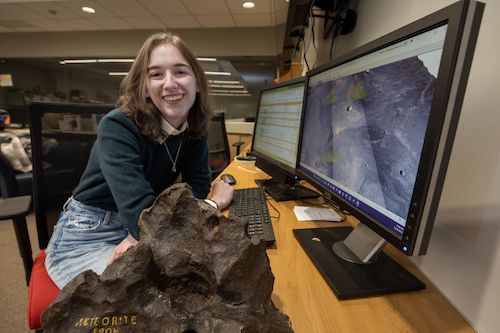 Kristen Norberg
Major: Geology, Earth and Space Sciences; Minor: Geospatial Science; Class of 2027
Research Mentor: Dr. Timothy Glotch, Geosciences
Kristen Norberg is a junior double majoring in geology, and earth and space sciences. Since September
2024, she has been doing research in The Vibrational Spectroscopy Laboratory in the Center for Planetary Exploration under the mentorship of Dr. Timothy Glotch
(Geosciences) and PhD candidate Eashan Das. As one of only two undergraduates in
the Laboratory, she has learned how to do geomorphological analysis and mass estimations
of 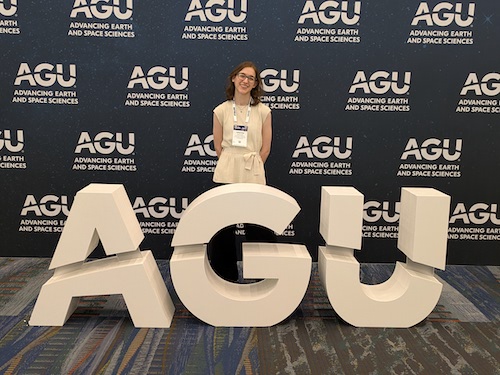 Martian chloride salt bearing deposits and how to process satellite imagery into salt
abundance maps; she also uses GIS to overlay abundance maps onto digital terrain models
for analysis. Recently, Kristen was selected to give an oral presentation at the American
Geophysical Union (AGU) annual fall meeting in New Orleans on “Geomorphological Analysis of Martian Chloride Salt-Bearing Deposits.” She is a co-author on a paper published in JGR: Planets (March 2025), and long-term plans to pursue a PhD in planetary geology or astrobiology.
Martian chloride salt bearing deposits and how to process satellite imagery into salt
abundance maps; she also uses GIS to overlay abundance maps onto digital terrain models
for analysis. Recently, Kristen was selected to give an oral presentation at the American
Geophysical Union (AGU) annual fall meeting in New Orleans on “Geomorphological Analysis of Martian Chloride Salt-Bearing Deposits.” She is a co-author on a paper published in JGR: Planets (March 2025), and long-term plans to pursue a PhD in planetary geology or astrobiology.
On campus, Kristen is active as a member of University Chorale, and the Astronomy Club;and serves as a Teaching Assistant for classical physics Lab I (PHY 133). She is the recipient of the Geoscience departmental Oliver Schaeffer Endowed Memorial Scholarship. When Kristen contemplates all the benefits of research she’s experienced, she recognizes an increase in her self confidence: “...a big thing has been gaining more confidence in being able to present my work, …. I’m feeling much more confident about the presentation because of all the experiences I’ve had in my research group. It makes things like the conference seem a little less daunting…"
Kristen is a graduate of St. Joseph Hill Academy and is from Staten Island. Her hobbies include: reading, sewing, art/drawing, gardening, gaming, and choir. Below are excerpts of her interview with Karen Kernan, URECA Director.
The Interview:
Karen: How did you first get involved in research at Stony Brook?
Kristen: Since high school, I’ve known that research was something I wanted to do. In my first year, I acclimated to being in college. But in sophomore year, I knew I wanted to start getting involved in research. I went to the open house for the Geosciences Department. (Every fall semester, the department hosts an open house for their programs, and I always go.) It was there that I started talking to the undergraduate geology advisor, Professor Marine Frouin about how I wanted to do research in planetary geology. She suggested that I reach out to Professor Tim Glotch. That afternoon, I got back to my dorm and sent him an email asking if I could meet to talk with him about an undergraduate research position in his lab. I met with him the next day and we talked about a project that I might be able to get involved with, and that basically was my start in the Vibrational Spectroscopy Laboratory.
What is your project about? What are you working on?
So, my project is the geomorphological analysis of chloride salt deposits on Mars. You’ve probably seen in the news that there was once water on Mars. These deposits may be indicative of the last signs of that water. Sodium chloride is one of the last salts to precipitate out of solution as water evaporates, meaning the study of these deposits may provide insight into the final stages of stable liquid water on Mars’ surface. By creating salt abundance maps from spectral data of Mars orbiters and overlaying them onto 3D digital terrain models of the surface, we can analyze potential depositional environments and perform calculation estimates for chloride mass. It's all for the goal of trying to figure out the origin of these deposits. There've been a lot of different hypotheses proposed regarding potential formation mechanisms, so creating and analyzing this imagery can help to increase understanding of these deposits and their potential origins.
What do you like most about doing research?
It's so rewarding! I think my favorite part about it is just knowing that I'm getting the chance to contribute to a scientific field that I really am so interested in. We have our team meetings once a week, and everyone in the lab goes around the table and gives updates on their work. As I sit there, I'm absolutely blown away by the different projects that everyone has. It's so incredible to me—the fact that I'm also at that table and have my own project that I'm working on. It is so rewarding to know that I'm able to contribute to a field that I find so fascinating, and that I have the opportunity to really be a part of the scientific community.
How were you trained to do research in the group?
I'm working most directly under a Ph.D. candidate in the lab, Eashan Das. I started out by just helping with some of the image processing steps, and then over time, I've gotten the chance to be more involved in the analysis.
I rememberthe first time I met with Eashan,I was introduced to 3 different programs that I was going to be using - none of which I had heard of before. I took a lot of notes! Writing down all the different steps and tasks I would need to do and asking questions definitely helped! And I received great instructions and guidance on how to use all these programs.
For the first few weeks, I was mainly reading literature for background knowledge on the project and I worked on just reproducing imagery that had already been made. I was trying to recreate results to make sure that I kind of had my footing in using these programs. It definitely becomes second nature the longer you do it. Over time, I've gotten a lot faster and more confident with doing some of the image processing. There's definitely a learning curve in the beginning, but everyone has to start somewhere, and learning is what performing research as an undergraduate is all about.
There are about 10 to 15 graduate students in total in our group, and they've all been super nice and welcoming. It was intimidating in the beginning to be one of only two undergraduates, but I've learned so much from the others there who have been working in this field for a longer time.
Professor Glotch has alsobeen incredibly encouraging throughout my whole time in his lab. I met with him earlier this semester to go through some of the images that I had been working on, and it was really great to hear his take on them and learn from his analyses of some of the features that we were seeing. He's provided amazing guidance and feedback and has been nothing but supportive throughout the whole process.
Is there anything that has surprised you about the nature of research?
For as much as I knew that this was a field that I was interested in, I didn't really know what research in this field entailed, especially in terms of actual work and day-to-day processes. I think it's easy to assume that we get data from orbiters around a planet, and that it's just good to go. In reality, there's a long process of taking that data that we get and turning it into something that we can actually sit down and analyze--turning it into something that we could use.
So that was really surprising, but it also makes it more rewarding at the end when we’re finally able to sit down and do that analysis part. We're getting into that stage now with analysis on the first region we've been looking at. Some of the images at this point, I know them like the back of my hand. I've seen them so much from doing all of those processing steps with them, but now we’re finally getting to sit down and look at them in a different way. As opposed to just “how does this image look?” we can move to the next step and ask: “ what can we actually gain from this image?” It’s really exciting to get to that point.
Do you see a lot of connection between what you do in lab and your coursework?
When I started doing this research, I was a sophomore, and I hadn't really gotten into the upper division courses for my major yet. So, when I started research and I heard about these programs we were going to be using, it kind of directed me towards what classes I should be taking and showed me what I needed to learn. I actually wound up picking up my geospatial science minor because that minor focuses on a program, ArcGIS, that I was using for research. I also took remote sensing this year, which is an upper division geology course that focuses on one of the other research programs, ENVI. So, in a sense… the research has guided me towards the classes that I should be taking. I'm grateful to Stony Brook because a lot of these classes cover fairly niche, specialized topics that some schools wouldn't even offer. Research has, in a way, given me direction and shown me that you can apply information from a ton of different areas when working on a project.
What are your future plans?
Getting a Ph.D. is my ultimate goal. My experiences in Professor Glotch’s lab have shown me what doing research is actually like and given me a better understanding of what graduate work will entail. I'm really grateful that it's been a long-term research project as opposed to just a semester because I've been able to see how you develop with a project over time. I’ve loved conducting research so far and my goal is definitely to continue along that path, so doing research has allowed me to visualize my future experiences going forward in this field.
If you were giving advice to a first year student, what would you tell them about research?
It’s hard to give advice that would apply to everyone's major without sounding super cliché, but I think the best advice that I could give is to not hold yourself back. It is easy to kind of count yourself out of opportunities before you even really try to take a chance. I've been in that mindset before, where you kind of think to yourself, “oh, there's someone else who's going to be more qualified, I haven't taken enough courses yet, I'm not old enough, etc.,” but that really doesn't get you anywhere. If you had asked me at the beginning of my sophomore year, before I started doing any of this research, if I would email a professor I had never spoken to and ask for a research position in his lab, I would have thought that sounded absolutely insane. But that's exactly what I wound up doing! And had I not done that, I wouldn't have a quarter of the experience that I have now. It’s said a lot, but it really is true that you lose nothing from trying. Send emails, talk to professors after class, put yourself out there because the potential benefits are so much greater than anything you may be worried about.
When you applied to Stony Brook, did you know that you wanted to do geology as a major?
I knew since high school that I was interested in planetary geology, although I didn’t know the term at the time. I remember I used to say, “I'm really interested in space, but specifically what's on the surface of other planets.” That train of thought led me towards a geology major. It’s not the most common major, so Stony Brook definitely stood out since it not only had the program, but had one that was clearly well-established. It’s funny because I remember researching Stony Brook’s Geosciences Department as a high school senior, and I would see Professor Glotch’s name in certain articles about work with NASA. It was one of the things that made me excited about some of the opportunities I might have if I came here to Stony Brook, so the fact that I ended up in his lab is really fun.
What for you is the value added to your education through your involvement in research?
Learning how to use these different programs and developing skills that are going to be useful in this field going forward is a benefit, certainly. I think for me, though, a big thing has been gaining more confidence in being able to present my work, whether it be for the one-on-one meetings I have with my grad mentor or for our weekly team meetings. Being able to present your research is a big part of the scientific community, so I think that’s a really important skill to develop that you don’t necessarily gain in the same way from presentations in your normal classes. That confidence has already come in hand since I recently had the chance to present at the American Geophysical Union annual fall meeting in mid-December.
Congratulations! Is this your first off-campus presentation?
Yes, this was my first time presenting off-campus. I was definitely nervous, but also very excited! And it went so well! I had the option of doing either a poster or oral presentation, and it was recommended by my grad mentor to apply for the oral session. I wound up getting selected for an 8-minute-long talk with 2 minutes for questions. I felt much more confident about the presentation because of all the experiences I’ve had in my research group. That experience makes things like the conference seem a little less daunting. So, that's one of the skills that I've gotten from my research experience.
The conference itself was such an incredible experience! It was amazing to be surrounded by so many people in the same or similar fields, all with their own projects and such clear passions for their work. Being able to sit in on some of the different talks and presentations was so valuable and really opened my eyes to all of the different specializations and topics that there are. It's such an exciting time for planetary research and it was such a great feeling to be able to present and contribute to the sharing of ideas within the community!