
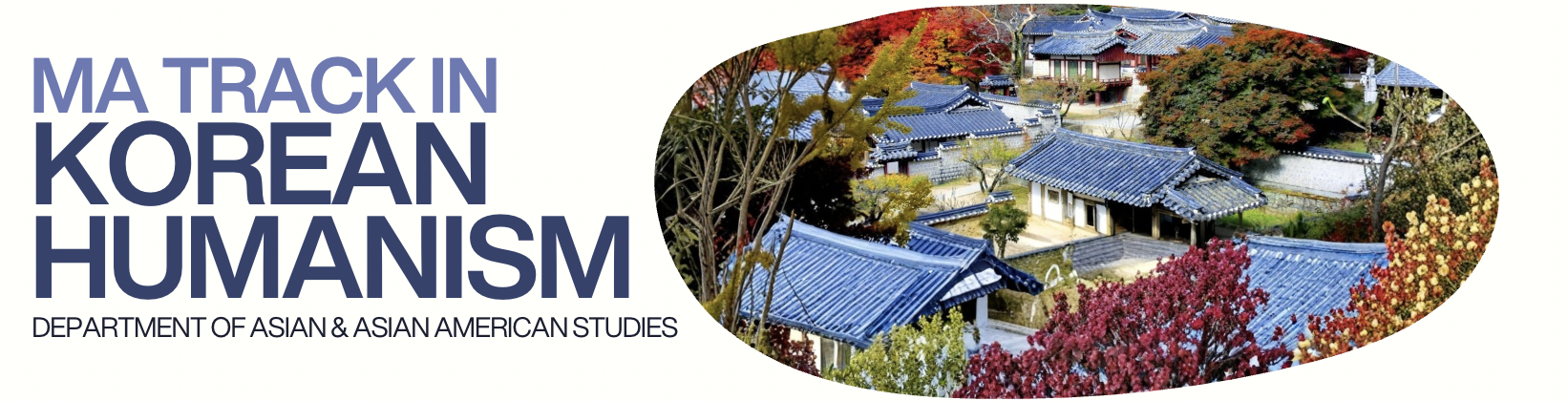
- Prgm Overview & Highlights
M.A. Track in Korean Humanism
A track in the Global Asias Graduate Program in the Department of Asian and Asian American Studies
Stony Brook University welcomes applications from around the world for its new M.A. track in Korean Humanism, a graduate program dedicated to training future scholars of premodern and modern Korean literature, history, culture, and philosophy. Designed for students with a commitment to advancing research on Korea's humanistic topics across all periods, the program aims to nurture well-rooted intellectuals and future scholars of Korea. It responds to a growing need for historically grounded, ethically informed perspectives in an era of global uncertainty, technological acceleration, and shifting cultural values. Through close engagement with classical and modern sources, students develop critical skills to rethink questions of humanity, knowledge, and responsibility across time and cultures. The program offers a rigorous, interdisciplinary curriculum, with full tuition support available for selected candidates. Students interested in all periods of Korean studies are welcome to apply.
Program Highlights
- Curriculum: A carefully curated 30-credit program completed over three semesters.
- Full Tuition Scholarships: Available to selected students for up to 30 credits, contingent upon maintaining a minimum GPA of 3.5.
- Interdisciplinary Approach: Study Korea’s heritage through literature, history, and philosophy.
- Primary Source Training: Develop the skills to read and interpret primary Korean materials.
- Career Preparation: Well suited for students planning to pursue careers in Korean Studies or East Asian Studies, as well as in professional fields requiring expertise in Korean humanism.
** Program Material: 2026 Program Brochure
- Course Design
The M.A. Track in Korean Humanism is a 30-credit program structured as follows:
I. Research Methods (3 credits)
AAS 501 Research Methodology: This course introduces qualitative and quantitative research methods used in the social sciences and humanities, including narrative, phenomenological, ethnographic, case study, correlational, and survey research. Students select a topic related to Contemporary Asian and Asian American students and develop a pilot research project.
II. Required Core Courses (12 credits)
AAS 511 Reading Classical Texts in Korean Humanism I: This course explores the Korean humanistic tradition through a close examination of selected classical works written before the 17th century.
AAS 512 Reading Classical Texts in Korean Humanism II: This course explores the Korean humanistic tradition through a close examination of selected classical works written after the 17th century.
AAS 536 Korean Humanism in Modern History: This course investigates the emergence, evolution, and transformation of Korean humanism from the late 19th to the 20th century.
AAS 538 Korean Humanists: Lives and Works: This graduate seminar explores the evolution of Korean humanist thought from the classical period through modern times by examining the lives and works of influential thinkers, reformers, and spiritual leaders.
III. Three Elective Courses (9 credits)
AAS 500 Intellectual History of East Asia: This course introduces the major intellectual traditions of East Asia, emphasizing that intellectual movements not only mirror historical change but also actively shape it. By situating these diverse traditions within a broader East Asian framework, the course explores how philosophy, religion, literature, and political thought both reflected and guided the historical trajectories of China, Korea, and Japan
AAS 523 Language and Society in Korea: A multidisciplinary exploration of Korean society and culture through language practices. The course examines how linguistic practices reflect and shape historical and sociocultural experiences.
AAS 532 Humanities Topics in Korean Studies: This course explores the evolution of Korean humanism as reflected in historical scholarship, literary traditions, and cinematic narratives from the late Joseon dynasty to contemporary South Korea.
AAS 533 The Unending Korean War: This course examines the unended/unending nature of the Korean War, paying special attention to how the war has been remembered, especially by those who contest the dominant historical narrative of U.S. benevolence.
AAS 537 History of Korea: This course examines Korean history from ancient to modern times. Korea is one of the ancient, non–European civilizations claiming a cultural influence on East Asia and beyond. Reflecting its unique historical experiences, Korean history has raised diverse debatable issues. The primary goal of this course is to provide an overview of Korean history and, at the same time, through introducing multiple debatable issues of historical significance, it attempts to enhance students’ analytical capability in approaching complicated historical issues.
AAS 539 Korean Literature: This course is an introduction of the literary tradition of Korea. It examines representative literary works selected from the corpus of Korean literature in various periods with special attention to their historical background and the aesthetic and cultural values that are embedded in them.
IV. A Thesis (6 credits)
- Teaching FacultyDr. Hongkyung Kim: Director of the Korean Humanism ProjectProfessor of Korean Philosophy, Confucianism, and DaoismPhD, Sungkyunkwan UniversityVisiting Associate Professor of Korean Philosophy and East Asian Intellectual HistoryPhD, Oxford UniversityAdjunct Professor of Korean Philosophy; Professor, Sungkyunkwan UniversityPhD, Yonsei UniversityAdjunct Professor of Korean Cultural and Intellectual History of the Twentieth CenturyPhD, Columbia UniversityAdvanced Senior Lecturer of Korean Modern HistoryPhD, Stony Brook UniversityAdditional FacultyDr. Sohl Lee, Associate Professor of East Asian ArtDr. Jiwon Hwang, Assistant Professor of Korean LanguageDr. Sandra So Hee Chi Kim, Assistant Professor of Korean American Studies
- Graduate ApplicationFall: May 1Early consideration: February 15
Click here to start your application.
** Note: Select “Global Asias MA” as your Program of Study in the application, and indicate in your essay that you are applying for the Korean Humanism track.
- Scholarship Application
With some support from the Academy of Korean Studies, we offer full-tuition scholarships for a small number of competitive students. To apply, please submit your graduate application first and then complete the separate scholarship application. Scholarship decisions are contingent upon admission to the graduate program.
Scholarship Application Deadline for Fall 2026 admission: April 30, 2026
Eligibility Requirements
- Admission to the M.A. track in Korean Humanism through the M.A. in the Global Asias program at Stony Brook University.
- Demonstrated academic excellence, with a minimum undergraduate GPA of 3.5 or higher.
- Clear commitment to pursuing research in Korean humanistic traditions.
Use this link to submit the scholarship application. The scholarship decision will be announced by May 15, separately from the graduate admission decision.
- Key FAQs
📖 PROGRAM BASICS
What is Korean Humanism?
Korean Humanism refers to Korea's rich intellectual tradition as expressed through classical literature, philosophy, and historical writings. These texts offer profound insights into questions of human dignity, ethics, community responsibility, and the relationship between humans and nature. Our program trains students to engage directly with these primary sources, understanding how Korean thinkers addressed fundamental questions about what it means to be human across different historical periods.
What makes this program unique?
This is the only MA program in North America specifically dedicated to training students in reading and interpreting premodern Korean texts in their original languages (Literary Sinitic/Hanmun and Classical Korean). While other programs offer Korean Studies more broadly, we provide intensive, specialized training in classical source materials—a rare and essential skill for serious scholarship in Korean humanities.
How long does the program take?
The program is designed to be completed in three semesters (one and a half years) of full-time study, totaling 30 credits. This accelerated timeline allows students to complete their MA efficiently while building strong foundations for doctoral study.
🌐 LANGUAGE REQUIREMENTS
Do I need to know Hanmun/Classical Chinese before applying?
No prior knowledge is required. The program is specifically designed to train students in reading Literary Sinitic from the ground up. Our curriculum includes systematic instruction in classical language skills, progressing from foundational texts to more complex materials. Students with prior exposure to classical Chinese will certainly benefit, but beginners are welcome and expected.
Do I need to be fluent in modern Korean? While fluency in modern Korean is not strictly required, proficiency in Korean is highly recommended and will significantly enhance your learning experience. Many secondary sources and scholarly discussions are in Korean, and strong Korean language skills will help you engage more deeply with the material. If your Korean needs strengthening, we can advise you on language study options.
What if I only know English?
Students with strong English proficiency and no Korean background may still apply if they demonstrate exceptional academic preparation and clear commitment to language study. However, be prepared to invest significant effort in developing Korean language skills alongside your coursework. We recommend starting Korean language study before the program begins.
Will I be able to read original Korean classical texts after graduation?
Yes! By the end of the program, you will have developed functional reading ability in Literary Sinitic and Classical Korean. You'll be equipped to work with primary source materials independently—a crucial skill for doctoral research, teaching, and professional work in Korean humanities.
💰 SCHOLARSHIPS & FUNDING
What does the full tuition scholarship cover?
The scholarship covers full tuition for up to 30 credits (the entire degree program). This is a substantial benefit, as graduate tuition at Stony Brook can exceed $25,000 per year for non-residents.
Are there additional stipends for living expenses?
While the primary scholarship covers tuition, additional support may be available through research assistantships or other funding opportunities. We encourage applicants to inquire about these possibilities during the admission process.
What are the requirements to maintain the scholarship?
Recipients must maintain a minimum GPA of 3.5 throughout the program. Given the rigorous but supportive nature of our curriculum, students who engage seriously with the material typically exceed this threshold.
How competitive is the scholarship?
We offer scholarships to a limited number of highly qualified students each year. Selection is based on academic excellence, demonstrated commitment to Korean humanistic studies, and potential for scholarly contribution. Strong applications include clear research interests, relevant academic background, and compelling personal statements.
Can international students apply for scholarships?
Yes, absolutely! The scholarship is available to both domestic and international students. International students are strongly encouraged to apply.
📝 APPLICATION PROCESS
What are the application deadlines?
- Graduate Application Deadline: May 1, 2026
- Scholarship Application Deadline: April 30, 2026
- Early Consideration: February 15, 2026 (recommended for best scholarship consideration)
** Please select “Global Asias MA” as your Program of Study in the application, and indicate in your essay that you are applying for the Korean Humanism track.
What materials do I need to submit?
For graduate admission:
- Completed online application
- Transcripts from all universities attended
- Statement of purpose
- Writing sample (10-20 pages)
- Three letters of recommendation
- GRE scores (if available, though not always required)
- English proficiency test (TOEFL/IELTS for international students)
For scholarship consideration:
- Separate scholarship application form (submitted after graduate application)
- Additional essay on research interests and commitment to Korean Humanism
What should I include in my statement of purpose?
Your statement should address:
- Your academic background and relevant preparation
- Why you're interested in Korean Humanism specifically
- Your research interests within premodern Korean literature, history, or philosophy
- Your career goals (especially if you plan to pursue doctoral study)
- Why Stony Brook's program is the right fit for you
What makes a strong writing sample?
Submit your best academic work (10-20 pages), preferably related to Korean Studies, East Asian Studies, or humanities research. It doesn't need to be about Korea specifically, but should demonstrate your analytical thinking, research skills, and writing ability. Papers on literature, history, philosophy, or cultural studies are all appropriate.
Do you accept students without a Korean Studies background?
Yes! We welcome students from diverse academic backgrounds including but not limited to:
- East Asian Studies (Chinese, Japanese, or Asian Studies)
- Comparative Literature
- Philosophy and Religious Studies
- History
- Linguistics
- Anthropology
What matters most is your intellectual curiosity, commitment to rigorous study, and genuine interest in Korean humanistic traditions.
🎓 ACADEMIC PREPARATION
I majored in something completely different. Can I still apply?
If you have genuine intellectual passion for Korean humanities and are willing to commit to intensive language and textual training, career changers are welcome. Be prepared to articulate clearly why you're making this transition and how your previous experience enriches your perspective.
Should I have research experience?
Prior research experience (undergraduate thesis, independent study, conference presentations) strengthens your application but is not required. We value intellectual potential and commitment as much as prior accomplishments.
💼 CAREER PROSPECTS
What can I do with an MA in Korean Humanism?
Our program prepares you for multiple pathways:
- Doctoral Study(Primary pathway)
- PhD programs in Korean Studies, East Asian Studies, Comparative Literature
- Our program provides ideal preparation for top doctoral programs at institutions like Harvard, Columbia, UC Berkeley, University of Chicago, Yale, etc.
- Education
- Korean language instruction (with additional teaching certification)
- College-level teaching in Korean Studies or Asian humanities
- Curriculum development for Korean culture programs
- Cultural Institutions
- Museums with Asian art or Korean collections
- Cultural centers and heritage organizations
- International educational exchange programs
- Public Service & International Relations
- Diplomatic service (with additional training)
- Cultural diplomacy and public affairs
- NGOs focused on Korea or East Asia
- Publishing, Translation & Media
- Literary translation (Korean classical texts to English)
- Academic publishing
- Cultural journalism and content creation
- Research & Think Tanks
- Korean Studies research institutions
- Policy organizations requiring deep cultural expertise
Is this program terminal, or is it for PhD preparation?
While it's technically a terminal MA, the program is ideally suited for PhD preparation. The intensive training in classical languages and primary source research provides exactly what you need for doctoral work. Many students will continue to PhD programs.
What about job market concerns for humanities PhDs?
This is a valid concern. However, Korean Studies specialists with classical language skills remain in demand because so few people have these capabilities. Additionally, our interdisciplinary approach (literature + history + philosophy) and practical language skills make you competitive for diverse careers, not just academia.
🏫 STUDENT LIFE & SUPPORT
Where is Stony Brook University located?
Stony Brook is located on Long Island, New York, about 60 miles east of Manhattan. The campus offers a suburban setting with easy access to New York City's museums, libraries, and Korean cultural institutions. The area has a significant Korean-American community.
Are there other Korean Studies resources on campus?
Yes! The Center for Korean Studies offers:
- Regular lectures and symposia
- Korean language courses at all levels
- Library collections in Korean Studies
- Active student community
- Cultural events and film screenings
Can I take courses outside the Korean Humanism track?
The program includes three elective courses (9 credits) which can be chosen from related offerings in Asian Studies, History, Philosophy, or other departments. This flexibility allows you to tailor the degree to your specific interests.
Will I have opportunities to present my research?
Absolutely! Students are encouraged to:
- Present at the annual Center for Korean Studies symposium
- Submit to graduate student conferences
- Work collaboratively with faculty members to co-author document translations
- Publish in student journals
Is there a community of Korean Studies students?
Yes. Beyond your cohort, you'll interact with students in the broader Asian & Asian American Studies MA program, undergraduate Korean Studies minors, and visiting scholars. The Center regularly hosts events that bring together the entire Korean Studies community.
What about mental health and wellbeing support?
Graduate study can be demanding. Stony Brook offers:
- Counseling and Psychological Services (CAPS)
- Graduate student support groups
- Wellness programs
- Peer mentoring
🌏 INTERNATIONAL STUDENTS
Are international students welcome?
Absolutely! We actively encourage applications from international students, especially those from Korea and other East Asian countries. The scholarship is available to international students.
What are the English language requirements?
International students whose native language is not English must demonstrate English proficiency through:
- TOEFL iBT: minimum score typically 90+
- IELTS: minimum score typically 6.5.0+
- Or equivalent
Strong English skills are essential for reading academic texts and writing your thesis.
Can I get a student visa (F-1)?
Yes. Admitted international students receive the necessary documents (I-20) to apply for an F-1 student visa. Stony Brook has extensive experience supporting international graduate students.
Is there support for international students?
Stony Brook's International Services office provides:
- Visa and immigration advising
- Cultural adjustment support
- English language support programs
- International student community
I'm still not sure if I'm qualified. Should I apply?
Yes! If you're genuinely passionate about Korean humanities and willing to work hard, we encourage you to apply. Let us evaluate your potential—don't self-reject. The admissions committee looks at the whole person, not just metrics.
What if I miss the early consideration deadline?
You can still apply until May 1st for graduate admission and April 30th for scholarships. However, early consideration (by February 15) gives you the best chance for scholarship awards, as funds are limited.
Is there a waitlist?
If scholarship funds are fully allocated, exceptional candidates may be admitted without initial funding but could receive scholarships later if they become available.
👉 If you have additional questions, please contact the Program Director: hongkyung.kim@stonybrook.edu

