
Japan Center Essay Competition Sponsored by Canon U.S.A.
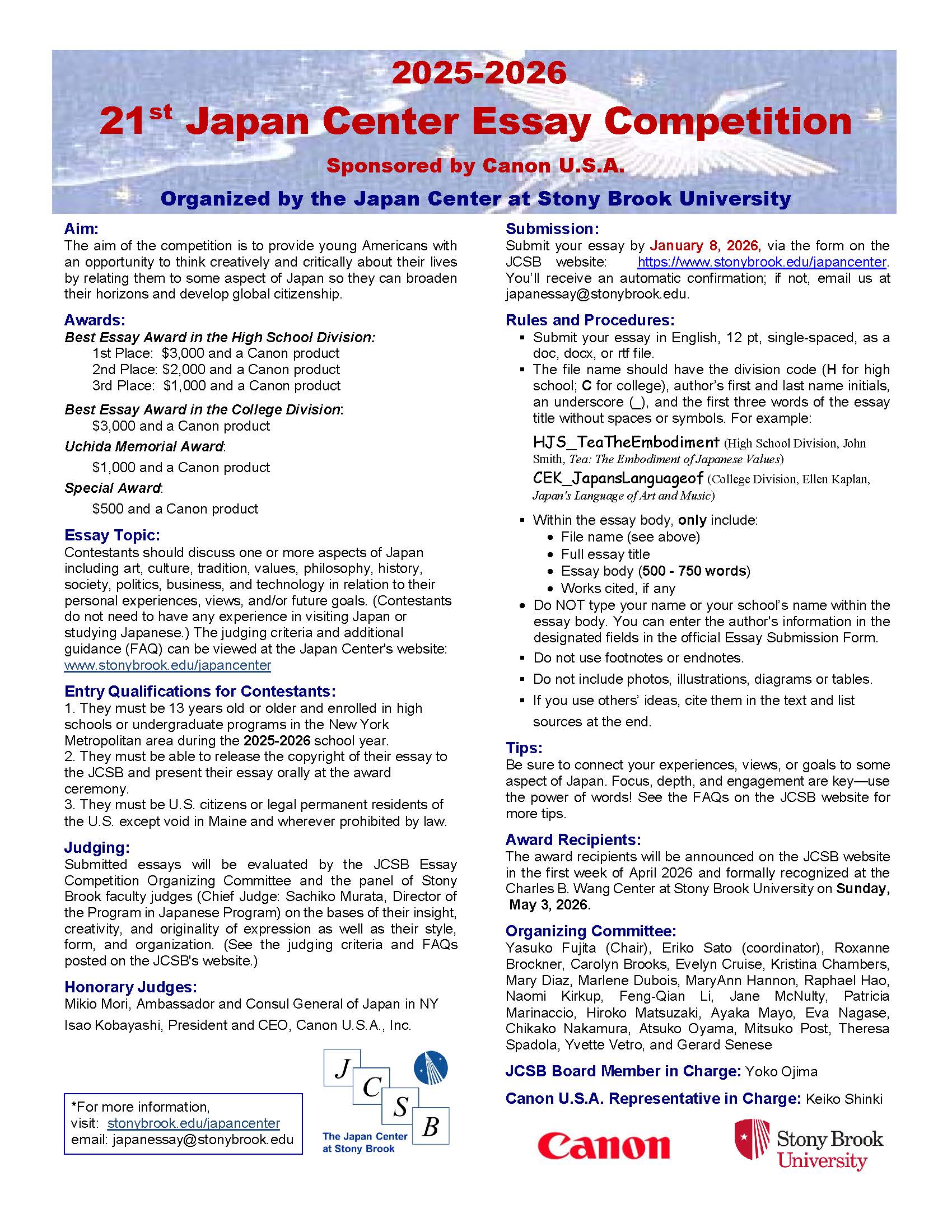
The aim of the JCSB essay competition is to provide young Americans with an opportunity to think creatively and critically about their lives by relating them to some aspect of Japan to help them broaden their horizons and develop global citizenship. Contestants should write, in English, one or more aspects of Japan including art, culture, tradition, values, philosophy, history, society, politics, business, and technology in relation to their personal views, experiences, and/or future goals. (Contestants do not need to have any experience in visiting Japan or studying Japanese.
The 21st Competition Results
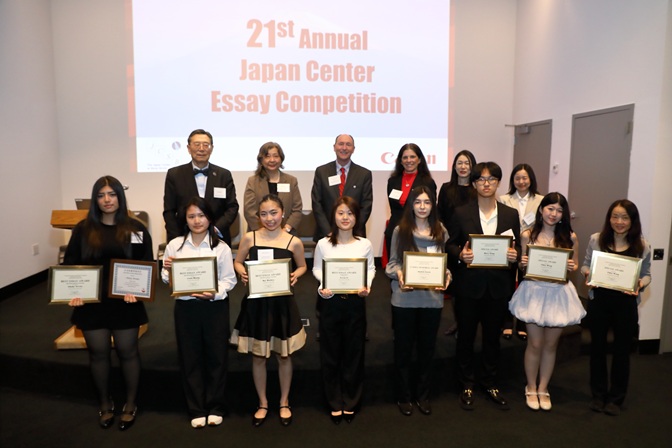
Winners
1st Place Best Essay Award in the High School Division and Consul General of Japan in New York Special Award
“Keeping the Shape: What Mujo Taught Me About Impermanence” by Chelsy Arrata (Locust Valley High School)
2nd Place Best Essay Award in the High School Division
“Tadaima: A Small Space with a Deep Return” by Venus Huang (Staten Island Technical High School)
3rd Place Best Essay Award in the High School Division
“Asadora: Exploring the Intergenerational Source of Inspiration for Japanese Women” by May Hachiya (Hunter College High School)
1st Place Best Essay Award in the College Division
“One Roll, One Soul” by Teresa Li (Stony Brook University)
Uchida Memorial Award
“The Concept of Ma and Learning to Embrace the Spaces In Between” by Anabela Garcia (Stony Brook University)
Special Award (*Alphabetically ordered by the author’s family name)
- “Kokoro wo Komete” by Barry Jiang (Staten Island Technical High School)
- “Gaman: As Hands Tremble, the Heart Endures” by Chloe Wang (Stuyvesant High School)
- “In the Name of the Moon: A Magical Girl’s Journey” by Chloe Wong (College of Staten Island High School for International Studies)
Finalists
Ruby Freda (United Nations International School)
Ari Kashanian (Stony Brook University)
Semifinalists
Naaz Asif (Stony Brook University)
Asmaa Khan (Stony Brook University)
Jack Kollmer (Chaminade High School)
George Kurakin (Stony Brook University)
Madison Lin (Syosset Senior High School)
Gianna Maniscalco (Stony Brook University)
Christopher McGratty (Wellington C Mepham High School)
Shaila Moulee (Stony Brook University)
Eshal Muzaffar (Staten Island Technical Highschool)
Sia Puri (Half Hollow Hills High School West)
Emma Reznik (Saint Anns School)
Hannah Thomas (Stony Brook University)
Kamran Towhid (Stony Brook University)
Selected Essays
1st Place Best Essay Award in the High School Division and Consul General of Japan in New York Special Award
“Keeping the Shape: What Mujo Taught Me About Impermanence” by Chelsy Arrata (Locust Valley High School)
Starting my sophomore year, I’ve kept a routine that feels like a small oath to myself. Every other Saturday, I hurry through the side entrance of my local library. I grab the novel that is trending that month, and then drift to the ground aside a label on the shelf that reads “Philosophy”. This section is quiet, with no one to hurry me, as I usually sit between the gaps of the shelves. One afternoon, a book with a slim linen spine caught my eye. “Essays in Idleness" by Yoshida Kenkō. I did not check it out, but when I arrived home, I rented the audiobook.
As I listened, I noticed how Kenkō lingers on what most would call ordinary things. Perhaps it is a lamp shutter, or a gate left open. He writes in chapters that never conclude, with nothing being forced into clarity. The word that rang my ears a couple times was “Mujo”, impermanence. He admires the flower that is about to fall, not the permanent blossom that never dies.
I began to see Mujo not as an unfamiliar Philosophy, but as something reflected in my life. My grandfather became an orphan as a teenager amidst Mao Zedong’s rise in 1949. When I was young, I interpreted his silence as him having nothing to say. After learning Mujo, I saw this silence was a selection. He was choosing which moments he wanted to carry forward and which to be left in the shadows. He never named the losses themselves, but instead, the feelings that pushed him forward. And when he did speak, his stories reflected Kenkō’s chapters: exact, but unfinished. A kettle boils. A door shuts. The scene just ends. And yet, he moves on.
Listening to Kenkō changed how I held these fragments of my grandfather's stories. Mujo doesn’t subtract his grief. It gives definition to it. If moments are fated to pass, then the people who survive them carry a responsibility. To carry the shape, not the illusion of it lasting. I began to see how my grandfather kept shape. He never wasted anything, something that most immigrant families take pride in. When his shirt buttons loosened, he repaired it with thread saved in a blue tin from his youth. When food remained in my bowl, he reminded me to finish it. This was not just an example of being resourceful, but a refusal to treat what remains as insignificant. Kenkō would view this attention as a form of beauty.
Mujo did not just follow me to their kitchen, but back to where I began. I continued to visit the library, but not to read. This time, I reorganized the display at the end of the philosophy aisle. I placed Essays in idleness beside other books. I left more space than usual in between the stands, allowing each book to exist separately. An older man stopped by to see what I was doing, and picked up Kenkō’s book. He explained that he had read it during a hard winter back in college. He said he liked the shortness of the chapters, because life had only given him short windows then.
Meaning does not accumulate by how much force we put into it, but only in what is allowed to pass. When I now ask my grandfather for a story, I do not push him past his pauses. I only note what he lets pass. Kenkō’s book has a line about dew on morning grass being the most moving when it trembles. I picture that when my grandfather’s voice begins to thin, then steadies. Mujo does not demand an ending. It allows the movement to arrive and pass by, intact.
Mujo has allowed me to honor change. It has taught me how to be a listener of a story that is not mine. On Saturdays, the routine continues, though now, never the same. I pick it up, and finally buy it. When I get home, I set the book down and fix a loose button on my jeans with the thread from the tin. The stitch is small, and borderline invisible. It holds because it does not pretend to be permanent. At that moment, I heard the lesson that linked a fourteenth century Japanese philosopher to a twentieth century boy who had to grow up changing, and now, to me. Mujo asks only this: Let the moment be finite. Keep the shape. Continue moving forward.
© JCSB
2nd Place Best Essay Award in the High School Division
“Tadaima: A Small Space with a Deep Return” by Venus Huang (Staten Island Technical High School)
The first time I stepped into Tadaima, a small Japanese cafe tucked away in a cultural oasis in Brooklyn, I felt something I didn’t expect: a quiet sense of recognition. The space could barely fit four people, yet it felt fuller than most places I’ve been to in the city. Cozy hues of amber pooled over the wooden shelves, quiet hums of conversation felt like a warm embrace, the air carried a faint sweetness of roasted tea, and the owner greeted me with a softness that felt strangely familiar. I soon learned that in Japanese, tadaima means “I’m home,” a phrase traditionally answered with okaeri, “welcome home.” But tadaima is more than just a greeting; it’s a ritual of return, a declaration of belonging. The cafe recreates this exchange through atmosphere rather than words. Its intimacy reflects the Japanese value of hospitality rooted in anticipation rather than performance, and even their desserts evoke a warm nostalgia. Tadaima’s mission to create a place where anyone can feel at home, is distinct in its belief that comfort can be crafted with intention. I had walked in as a stranger, but the space invited me as if it had been expecting me.
What surprised me most was how deeply this space resonated with my own story. As a child of immigrants, I grew up navigating two cultures that didn’t always speak to each other. Home has always been a shifting landscape of languages, expectations, and quiet misunderstandings. Tadaima felt familiar in the way that it mirrors the emotional in‑between I knew so well, the longing for a place where you don’t have to translate yourself to be understood.
On my first visit, I remember ordering a black sesame madeleine. The first bite caught me off guard; it was delicious and not too sweet, but also familiar. I’ve had black sesame desserts multiple times before, but this one in particular reminded me of the black sesame steamed cakes my grandma used to make. Its taste wasn’t quite the same, but it carried the same intention: a small act of care offered quietly. As I ate, I watched another customer sink into their seat with the same unguarded ease. At that moment, I understood what the owner meant by wanting to create a place where people could “come home to.” The cafe taught me how to recognize home.
Tadaima shifted the way I think about belonging. I used to believe home was something inherited, tied to geography or family history. But the cafe showed me that home can also be built through intention and the small choices that make people feel seen. It taught me that community isn’t formed by proximity but by care. I walked into Tadaima expecting dessert and left with a new understanding of what it means to belong. Japan taught me this lesson long before I ever set foot in the country, that home is not a fixed point but a practice of welcoming and being welcomed. As I step into new communities, I carry with me a commitment to creating spaces where others can feel the quiet relief of saying, in their own way, tadaima.
© JCSB
3rd Place Best Essay Award in the High School Division
“Asadora: Exploring the Intergenerational Source of Inspiration for Japanese Women” by May Hachiya (Hunter College High School)
My eyes were glued to the TV, with pupils dilated and mouth ajar. What could have possibly intrigued a three-year-old so much? Although popular cartoons among toddlers equally fascinated me, the only shows that ever evoked my five senses were Asadoras. Asadora is the colloquial name for NHK’s morning drama series known as Renzoku Terebi Shōsetsu. It is a combination of the words asa and dorama, meaning morning and drama, respectively. The series features separate dramas, each lasting around half a year, mostly following the lives or generations of female protagonists across different time periods. Across Japan, many have habituated watching the 15-minute episodes every Monday through Friday morning with their families, just as my mother did with her late mother and I do with my mother.
Some of these dramas are based on true stories, depicting the lives of legendary Japanese women or the wives of prominent Japanese men. Asadoras depict the lives of wives without reducing their identities to just female spouses of men like the inventor of instant noodles, the creator of Anpanman, and a composer from the post-WWII era. Other stories are fictional and highlight the beauty of women who lead both noble and ordinary lives. From time to time, asadoras feature male protagonists, whose lives are no less inspirational. Nonetheless, I have always been particularly captivated by those narrating the lives of inspirational Japanese women.
I clearly remember watching Ama-chan, my first asadora, from April to September 2013. Though I have forgotten its plot, I remember the opening scene vividly. Against the exclamatory notes of brass wind instruments in the bright, almost goofy key of C major, beam clips of Japan’s breathtaking yet approachable rural scenery. Occasionally, a high school girl, the main character who aspires to become a mainstream idol, appears with a youthful, radiant smile—the one that made me think she loved and lived life to the fullest. I was energized by this one scene every morning: my goal was to become a pretty, charming, and joyous girl who, like her, donned a sincere smile extending from one ear to the other.
As I have matured across the tens of asadoras I have watched, so have the messages that I absorb from such dramas. The younger me was taught about the realities of society and the way the world functioned. One lesson that struck me deeply was that a comfortable childhood was a privilege while some peers led much different lives, and that, regardless of such disparities, their lives were equally worthy of respect. When I was a tween and frequently initiated family arguments, I found myself asking for solutions in the asadoras, calming myself through my observations that the protagonists also experience rough patches with their parents.
Now, navigating high school, I am committed to discovering my individual identity via asadoras. I seek out role models and consciously aim to adopt certain traits or attitudes of theirs that I admire. More recently, Tora ni Tsubasa has become my all-time favorite asadora. This drama explores the real-life story of a monumental figure—the first female judge and one of the first female lawyers in Japan. As a girl who has gradually developed a keen interest in law and social justice, I felt connected to the equally considerate, bold, and resilient protagonist, solidifying my passion. I am waiting eagerly to unravel the next new essences I will draw from asadoras.
Asadoras appeal to viewers through shared humanity. Despite living in New York, an environment far removed from the one that the protagonists of asadoras inhabit, I often find myself in them effortlessly. One of the factors that unites us is our Japanese heritage—a set of core values, family dynamics, and traditions that shape our lives.
I develop my identity partly by living through their tribulations and revelations; I cry with, laugh with, and marvel at the lives of powerful women on screen and the powerful woman beside me, my mother. She tells me that asadoras are reminders of her personal aspirations that were buried under her priority of being a good mother. They include her love for music composition as a former professional pianist, which she has recently reclaimed, partly motivated by the hardworking, dedicated protagonists and their mothers. Asadoras communicate that she does not need to surrender her own goals to her maternal responsibilities and, instead, can chase her own dreams. Together, alongside generations of women, we have navigated and will continue to navigate our separate yet intertwined definitions of women's lives.
© JCSB
Best Essay Award in the College Division
“One Roll, One Soul” by Teresa Li (Stony Brook University)
My father has only ever had two jobs in his entire life.
The first was as a griller at a buffet restaurant, a job he took when he was still young and unsure of where life would lead him. It was the only job he could apply for. He had no education, no diploma to prove his worth, and no safety net to catch him if he failed. At 18 years old, he left his home and came to the States alone, carrying nothing but the belief that working hard was the way to survive.
That belief found meaning when my uncle opened a sushi restaurant.
My father became a sushi chef, and from that moment on sushi was no longer just food, it was his life. At the time, he did not yet have a family. He had no children waiting for him, no home filled with voices. Sushi was the only thing that belonged to him, the place where his effort turned into something visible. Behind the counter, nothing else mattered.
His creativity bloomed behind the sushi bar. He created the restaurant’s most popular item: the Bamboo Roll. It was light, delicate, and unforgiving, filled with masago, seaweed salad, eel, spicy white tuna, and crunchy tempura, wrapped tightly in cucumber and topped with avocado. If his hands were careless, the roll would fall apart. He rolled each one slowly and tightly, his scarred fingers steady, treating each roll as if it were fragile and alive.
There is a Japanese saying, Ikkan nyūkon. One piece, one soul. For sushi chefs, it means every piece carries the spirit of the person who made it. That phrase was my father. His soul lived in his hands. Every cut and every plate carried his patience, pride, and quiet hope that this life of labor would one day be enough.
For years, the restaurant thrived. Then one night, it burned down.
Dust in the ventilation filter sparked and ignited a fire. As flames swallowed the place that had defined his life, my father called me. His voice did not shake. He said the restaurant was gone. That restaurant had existed before I was even born. My family had moved into an apartment across the street so he could work longer hours. Even after we moved farther away, he spent two to three hours commuting by public transportation each day. He had helped create the menu, shape the identity, and build the soul of that place. In one night, everything those hands had built turned to ash.
The restaurant closed permanently due to unsafe conditions. My father’s life’s work became uncertain. He searched for another job while my uncle tried to find a place to reopen. At home, things unraveled. My parents argued constantly. He did not know how to solve problems that life has given him. His hands knew how to hold a knife, how to fix mistakes behind the sushi counter, but life outside the restaurant demanded answers he did not have. At work, every problem had a solution. Life was not that easy, it did not allow him to start over.
He became quiet and hesitant, unsure of where to place his hands. It was as if he tried to roll himself inward, folding his emotions tightly the way he once did sushi, hoping that if he stayed contained enough, nothing else would spill apart.
Eventually, my uncle found a small deli willing to rent to us. The narrow sandwich counter became my father’s last hope. His hands were rougher than ever. Chapped, split open, scarred, but he returned to work again. This time, my uncle had already given up. Customers slowly disappeared. We passed out menus, made social media accounts, and tried everything.
The old restaurant had been warm and alive, filled with soft music, bright lights, and decorations. The new place was cold and silent. Customers grabbed premade sushi without ever ordering. There was no music, only silence.
Month by month, something inside him broke. Ikkan nyūkon no longer lived in his hands. His rolls became sloppy, his movements mechanical. It was as if the Bamboo Roll, the symbol of his pride, was unraveling, his love and hope spilling out through the cracks in his scarred fingers.
At last, he closed the restaurant.
As I type this essay, I look at his hands resting quietly. Dry, scarred, motionless. I feel grief. Not just for the restaurant he lost, but for the part of him that disappeared with it. The part that once believed that if he put his soul into something, it would be enough.
© JCSB
Uchida Memorial Award
“The Concept of Ma and Learning to Embrace the Spaces In Between” by Anabela Garcia (Stony Brook University)
Throughout my adolescent years and well into adulthood, there has always been an intense feeling of inadequacy largely due to my own perception of productivity and progress. The still moments in my life that were not immediately tied to a goal felt like confirmation that I was falling behind. These moments felt stagnant and the encompassing emptiness was filled with anxiety and fear that I was allowing time to slip through my fingers. I spent most of my life convinced that true fulfillment was achieved by adhering to a singular correct pace for living – one rooted in constant movement and rapid growth. My preconceived notions shattered when my path diverged from my expectations as I faced multiple gaps in my academic career and the spaces in between leaving and returning felt synonymous with failure.
Embedded within Japanese culture is the concept of ma that is present in art, architecture, music, and social interaction. Rather than viewing emptiness as a void to be filled, this philosophy offers an alternative perspective in that it appreciates the spaces in between moments, such as silence or pauses. Ma recognizes the significance of absence and its presence helps to shape meaning and give purpose to all that surrounds it. Within this framework, stillness in life is viewed as a valuable force that helps to shape our actions and experiences.
After initially learning about ma, I found myself questioning my own beliefs in what emptiness represented. For as long as I could remember, I associated stillness with failure and had negative interpretations of moments of pause. However, I realized that refusing to acknowledge the empty spaces in my life would hinder growth and trap me in a cycle of anxiety, one that would lead me to become a victim of my own fears rather than learn from it. Ma allowed me to recontextual the period of time I had once viewed as stagnant; though these moments were fraught with self-doubt and fear, they were not lacking meaning. While these instances felt uncomfortable, they allowed me to confront uncertainty and learn how to navigate life within that vulnerability.
This new perspective has profoundly impacted how I view the gaps in my academic journey. As someone who has always valued education, deviating from my expectations felt defeating and brought forth a deep sense of embarrassment. I watched as those closest to me moved forward along their own paths whilst I remained still, certain that I was falling behind and incapable of succeeding. And yet, ma taught me that there can be meaning in these intervals of absence. Those moments allowed me to grow as a person and develop a deeper appreciation for my current time at university. They gave me the space to address my own mental health that prevented me from growing, reevaluate my priorities, and face my goals with determination.
As I look towards my future, I’ve come to accept that like ma, my journey includes significant intervals of pause that give greater meaning to what follows. Though my pace may be different from those around me, it’s not any less valid and does not diminish my own capabilities. Progress is not always visible, nor is it always loud. Sometimes, it unfurls quietly from within us in still moments of reflection. These moments that I once feared are now ones I realize are necessary in creating a balanced and meaningful life.
© JCSB
Special Award (A)
“Kokoro wo Komete” by Barry Jiang (Staten Island Technical High School)
Frank's shift ended at 5:00 PM. I watched him put on his jacket in the break room, keys jingling in his pocket. "See you tomorrow, Barry," he said, waving as he headed toward the exit. I went back to the unit, assuming he'd left for the day.
Thirty minutes later, Frank was still there.
I found him in Room 312, sitting beside Sarah's bed. Her surgery was scheduled for tomorrow morning, and I could see her hands trembling as she tried to hold her water-cup. Frank wasn't checking vitals like he usually did. He was just talking to her. About his own surgery five years back. About what the anesthesia would feel like. His voice was completely different from the joking tone he usually used with me. It was calm, unhurried, like he had nowhere else to be.
When he finally stood to leave, I noticed her hands had stopped shaking.
I didn't fully understand what I'd witnessed until later. As a sixteen-year-old volunteer, I'd been taught efficiency: complete your tasks, don't fall behind schedule. Healthcare runs on speed, on maximizing how many patients you can see in an hour. Frank had clocked out half an hour ago. He wouldn't be paid for this time. But he stayed anyway.
Those thirty minutes seemed oddly familiar.
My parents are Chinese immigrants who run a Japanese restaurant. Growing up, I watched my mother stay late perfecting the appearance of each sushi-roll even when the restaurant was empty. I saw my father remember that Mrs. Chen always wanted low-sodium soy sauce, and that the Johnsons preferred the corner table.These weren't just business tactics.
This was omotenashi, a Japanese approach to hospitality that my parents had learned and adopted as their own.
Omotenashi doesn't translate neatly to "hospitality." It's about genuine care without expecting anything in return. When I started working weekend shifts at fourteen, I used to get frustrated when my father made me re-pack orders or adjust the angles of a plate. It seemed excessive, unnecessary.
"Why does it matter?" I asked him once.
He paused, setting down the teapot he was arranging. "When someone walks through that door, they're trusting us with their time. We should honor that."
He told me about kaizen, the philosophy of continuous improvement through small, intentional changes. Asking yourself each day: what's one small thing I can do better? Greeting regulars by name. Noticing when someone seems tired and offering them tea without being asked. Over time, these tiny adjustments turned customers into family-friends.
Sitting in that hospital hallway, watching Frank walk past me toward the exit for the second time that evening, I saw kaizen and omotenashi. What Frank did for Sarah wasn't in his job description; those thirty minutes were his own time, his own choice. Just like my parents staying late to perfect details no one asked for. Both were practicing the same principle: that small acts of genuine care create profound impact.
Frank had never been to Japan. My parents came from China. That's what struck me most powerfully. These weren't just Japanese concepts locked behind culture or language; omotenashi and kaizen were human approaches to care that anyone could practice, anywhere. They were about choosing to give more than what's required because someone's wellbeing matters.
I'm studying to go into medicine now. Medicine does incredible things with technology, but I want to practice the kind of medicine Frank showed me that evening in Room 312. The thirty-minutes spent making sure someone feels heard. The small, consistent presence that transforms anxiety into trust.
My father always said “kokoro wo komete”–to put your heart into something. Not for recognition, but because the act itself matters. I saw it in how my parents treated every customer who walked through their door. I saw it in how Frank sat with Sarah long after his shift ended.
When my father finally taught me his Miso-Soup recipe, he only said 6 words: "Just pay attention. Care about it."
I think about that often now. About Frank and Sarah. About my parents and their restaurant. About how the most meaningful care often happens in moments that don't show up on paper. Small acts, repeated consistently, that accumulate into something larger than their individual parts.
Frank taught me that healing isn't just about medical intervention. Sometimes it's about choosing to stay thirty minutes past your shift. Sometimes it's about kokoro wo komete. Putting your heart into it, one small moment at a time.
© JCSB
Special Award (B)
“Gaman: As Hands Tremble, the Heart Endures” by Chloe Wang (Stuyvesant High School)
During moments of pressure, people often tell us to keep our composure and not let
fear or frustration show. But anyone who has ever stood across from an opponent in
a high-stakes debate round knows how impossible that can feel. Across from me, three
judges watch every gesture, every pause, and every word. Their eyes search for any
weakness, their pens scratching judgments I cannot see.
I remember one round that left its mark more than any other: the Quarterfinals at States. My opponent was confident, measured, and quick-witted. The room smelled faintly of paper and disinfectant, but all I noticed was the thrum of my own pulse in my ears. My legs shook beneath the table, my jaw ached from clenching so tightly that my mouth had the metallic taste of blood, and my hands hovered over the keyboard, struggling to press the right keys because my hands were trembling. The floor vanished beneath me, and I hung there, teetering over the edge.
The round began. My opponent had the first speech; he read aloud arguments I had studied dozens of times and prepared for just hours before. But upon hearing them, my mind went blank, overloaded with thoughts. The weight of expectation pressed down, not from the judges, but from myself. After his speech, I asked for two minutes of prep time. My heart raced as I scrambled to form a response, scanning through my Google Docs and reviewing my notes. Before I knew it, the two minutes were up. My throat tightened, but I started speaking. My voice quivered at first, then I forced it to steady. Each sentence felt like a step across a narrow bridge. I imagined the judges catching every tremor, every pause, and every slip, but I could not let that stop me. I argued point by point, responding to rebuttals I hadn’t anticipated, adrenaline sharpening me even as exhaustion clawed at my mind.
It was in that moment that I finally understood Gaman, a word I had heard growing up in a diverse Asian household. My dad used it to describe the kind of strength that doesn’t announce itself, enduring hardship with self-control and quiet dignity. He never meant pretending pain wasn’t there but carrying it without complaint and continuing forward anyway. Gaman values restraint over display, perseverance over comfort, and composure even when circumstances feel unbearable.
Standing there, shaking, I realized Gaman was not the absence of fear. It was fearfully present, acknowledged, and endured. It was continuing to speak while my hands trembled, staying upright when my knees threatened to give out, and choosing engagement when every instinct urged me to stop. Gaman was not dramatic or visible. It was private and uncelebrated, unfolding quietly in my body as I forced myself through each argument.
Every point I delivered became an exercise in this endurance. Gaman did not make the round easier, nor did it calm me. Instead, it anchored me. I felt every heartbeat, every shift of weight, yet I stayed present. The judges could not see how tightly I was holding myself together, but they could see that I remained standing, and that felt like enough.
When the round ended, I sank back into my chair, trembling, sweat cooling along my neck. I had not succeeded because I was flawless or eloquent. I had survived by enduring.
Beyond debate, Gaman follows me into procrastinated assignments, exhausting practices, and high-stakes exams. It has taught me that strength is often quiet and easily overlooked. It is not always rewarded or acknowledged. Sometimes, it exists only in the moment where stopping feels easier than continuing, and you continue anyway.
The debate revealed this kind of endurance to me. The long nights, the relentless scrutiny, and the pressure to perform showed me a form of courage that does not demand attention. It is restrained, steady, and persistent. It is choosing presence over panic, movement over paralysis, even when the outcome is uncertain.
Now, Gaman shapes how I face pressure beyond competition. Strength does not come from avoiding fear or hardship. It comes from carrying them forward, step by careful step, and remaining upright when everything urges you to fold. In every debate, every challenge, and every moment of doubt, I practice this endurance; quietly, imperfectly; until it becomes less of a lesson and more a part of who I am.
© JCSB
Special Award (C)
“In the Name of the Moon: A Magical Girl's Journey” by Chloe Wong (College of Staten Island High School for International Studies)
I have always wanted to be a magical girl. Not a barbie doll, not a powerpuff girl, not even a Disney princess. I wanted to be a magical girl, like Sailor Moon or Cardcaptor Sakura. I wanted to live two completely different lives—as a high school student and a world-saving heroine. My younger self would illustrate these aspirations in my 14x4 Totoro-covered sketchbook, hoping to one day become an aspirational hero of the people.
Yet I never stopped to think about what actually made someone a magical girl. Perhaps it was the sparkling wand studded with jewels? Or those over-the-top transformation sequences that somehow no villain ever interrupted?
My 10-year-old self loved the idea of having two identities, both successful and both effortlessly beautiful. Yet finding a way to unite these worlds felt impossible. After years of idealizing my high school experience, I finally joined pageantry in my junior year, where beauty could serve a purpose. Visiting Japan with my local title opened my eyes to the truth: it is discipline that makes a magical girl.
Long before my visit to Japan, I had found my own transformations at Anime NYC. Every year, I would spend weeks crafting cosplays—hand-sewing costumes, styling wigs, perfecting my “dolly makeup”. The convention floor became my stage, where I could embody the characters I'd admired since childhood. These annual pilgrimages were my first real lessons in what I would later recognize as a fundamentally Japanese approach to self-presentation: the understanding that humans are multifaceted, and that intentional transformation is not dishonesty but artistry.
I visited Japan in 2025 with my school for their annual international trip. Although I knew about Japanese culture through its cultural similarity to other East Asian countries and my admiration for Japanese media, nothing prepared me for this island country to be the catalyst of my epiphany. Yet Japanese culture didn't occur to me all at once. It unfolded in layers, like the transformation sequences I'd watched hundreds of times.
Walking through Tokyo, I noticed how the city itself lived a double life. By day, streets hummed with salarymen in crisp suits and students in uniforms, everyone moving with quiet efficiency. By night, those same streets exploded into neon-lit wonderlands, in regions like Akihabara where tradition and modernity collided in takoyaki parlors next to centuries-old shrines. This wasn't chaos; it was intentional coexistence, a cleavage that allowed Japan to honor its past while embracing its future.
This duality was woven into Japanese society's fabric through the concept of *tatemae* (public facade) and *honne* (true feelings). This philosophy mirrored exactly what I'd always loved about magical girls: the ability to navigate multiple identities without losing yourself. Usagi Tsukino could be clumsy and late for school, yet transform into the elegant Sailor Moon who bore the weight of protecting the world. She didn't have to choose between these selves; both were authentic and necessary.
The transformation sequences I'd memorized as a child suddenly revealed themselves as something far more profound than entertainment. The careful attention to uniform details, the specific gestures and phrases used during transformation, the respectful acknowledgment of responsibility before taking action—all of these echoed the cultural values of mindfulness, duty, and presentation that define Japanese society.
In Kyoto, I watched geishas move through Gion, their white-painted faces and elaborate kimonos transforming them into living art. Like magical girls, they maintained professional identities separate from their private lives, performing their roles with grace and precision. I saw the same philosophy in a tea ceremony, where every movement carried meaning, where preparing tea became something transcendent. This is what Japanese culture values: the elevation of the ordinary through discipline and attention, the transformation of daily rituals into art.
Japanese culture has fundamentally shaped how I understand myself and my aspirations. My pageant crown became my transformation compact—a tool that allowed me to step into a role where I could be both beautiful and impactful, both myself and something greater.
I already was a magical girl.
As I pursue my future goals of being a future lawyer that changes lives, I carry these Japanese cultural values with me: the understanding that mastery requires patience and that presentation matters because it reflects one’s respect for others. Japan didn't just introduce me to magical girls; it showed me I'd been living as one all along, enlightened by a culture that believed a girl could save the world without losing herself in the process.
© JCSB

Sponsor: Canon U.S.A.
Supporter : Consulate General of Japan in New York
Honorary Judges:
Mikio Mori, Ambassador and Consulate General of Japan in New York
Isao Kobayashi, President and CEO, Canon U.S.A.
JCSB Board Member in Charge: Yoko Ojima
Canon U.S.A. Representatives in Charge: Keiko Shinki
Organizing Chair: Yasuko Fujita
Coordinator & Principal Judge: Eriko Sato
Chief Judge: Sachiko Murata
Committee members: Carolyn Brooks, Collin Carter, Evelyn Cruise, Kristina Chambers, Mary Diaz, Marlene Dubois, Yasuko Fujita, MaryAnn Hannon, Raphael Hao, Feng-Qian Li, Patricia Marinaccio, Hiroko Matsuzaki, Ayaka Mayo, Eva Nagase, Chikako Nakamura, Atsuko Oyama, Mitsuko Post, Gerry Senese, Yvette Vetro, and Gerard Senese
 "Heart of Japan” was published in 2016. It is a collection of 70 essays selected from 1,992 essays submitted through 169 local colleges
and high schools during the first ten annual essay competitions. This essay competition
was launched in 2005 with generous donation from Canon USA. The aim of this program
is to encourage young Americans to think outside the box and find a connection to
Japan, a culturally very distinct country. They often reflect on their personal experiences
and their future goals and come up with unique and original thoughts, some of which
make us in tears and fill us with positive spirit. The essays are screened by the
Japan Center’s committee members and a panel of judges that consist of Stony Brook
University’s faculty members. The winners are formally recognized at the award ceremony
that takes place at the Wang Center in each spring and the top winners have been invited
to the Japanese Ambassador’s residence for a formal luncheon with the ambassador,
which has been creating once-in-lifetime memories for young writers.
"Heart of Japan” was published in 2016. It is a collection of 70 essays selected from 1,992 essays submitted through 169 local colleges
and high schools during the first ten annual essay competitions. This essay competition
was launched in 2005 with generous donation from Canon USA. The aim of this program
is to encourage young Americans to think outside the box and find a connection to
Japan, a culturally very distinct country. They often reflect on their personal experiences
and their future goals and come up with unique and original thoughts, some of which
make us in tears and fill us with positive spirit. The essays are screened by the
Japan Center’s committee members and a panel of judges that consist of Stony Brook
University’s faculty members. The winners are formally recognized at the award ceremony
that takes place at the Wang Center in each spring and the top winners have been invited
to the Japanese Ambassador’s residence for a formal luncheon with the ambassador,
which has been creating once-in-lifetime memories for young writers.

Book cover photo © Yvette Vetro
Past Competitions:
20th competition;19th competition;18 th competition; 17th competition; 16th competition; 15th competition; 14th Competition; 13th Competition;12th Competition; 11th Competition; First ten competitions