
IceCube
Main Project:
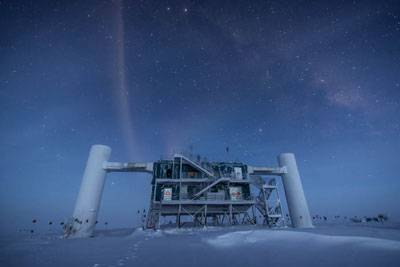
IceCube Neutrino Observatory, located in Antarctica, consists of a 1km3 underground high energy neutrino detector, a low energy neutrino sub-detector, and a surface cosmic ray array. The science program is multi-disciplinary, spanning research areas from astrophysics to particle and nuclear physics of electro-weak and strong interactions. Completed in 2011, IceCube opened a new way of searching for extra-galactic astrophysical sources of highly accelerated cosmic rays with neutrinos. The unexpected high flux of cosmic neutrinos measured below 100 TeV remains a puzzle and indicates the existence of astrophysical environments that are not detectable with gamma-rays. To date, no neutrinos have been observed with energies above 10 PeV. This indicates that even a larger detector is needed to detect very low fluxes at ultra-high energies and to probe - with ultra-high resolution - the structure of matter at the largest parton densities.
Our Publications:
IceCube Collaboration publications:
https://icecube.wisc.edu/science/icecube/
Contributors:
|
Professor: |
Joanna Kiryluk |
|
Graduate student:
|
Zheyang Chen Zelong Zhang |